Sheet 01 · Taskbar network meter

NetSpeedMonitor puts live network speed on your Windows taskbar

NetSpeedMonitor is a lightweight network monitoring tool that displays real-time download and upload speeds directly on your Windows taskbar. Easily track internet speed, monitor bandwidth usage, and keep an eye on your network performance.

Version
2.5.4.0
Licence
Freeware
Installer
MSI · x86 / x64
Built for
XP to Windows 7
Schematic of the NetSpeedMonitor taskbar toolbar Original drawing, not a screenshot. Windows counts the traffic of the selected network adapter; NetSpeedMonitor turns those counters into a download row marked D and an upload row marked U beside the taskbar clock. A right-click menu opens Connections, Data Traffic, Configuration and Quick Links, and hovering shows session, day and month totals. 01 · SIGNAL PATHSECTION A · NTS NETWORK ADAPTEREthernet · Wi-Fi INTERFACE COUNTERSbytes in · bytes out NETSPEEDMONITORbytes → rate Session · today · month totals ConnectionsData Traffic ConfigurationQuick Links D:--- kbit/s U:--- kbit/s D: --- kbit/sU: --- kbit/s DETAIL A · ENLARGED TASKBAR SCHEMATIC · NOT A SCREENSHOT NSM-01 TOOLBAR SCHEMATIC A B C D
  • ADownload rate, labelled D:
  • BUpload rate, labelled U:
  • CRight-click menu: Connections, Data Traffic, Configuration
  • DHover tooltip with session, day and month totals

Sheet 02 · What it is

What NetSpeedMonitor is

NetSpeedMonitor is a taskbar toolbar, not a window. It sits next to the notification area and shows two numbers that keep changing: how fast data is arriving and how fast it is leaving through one network adapter you choose.

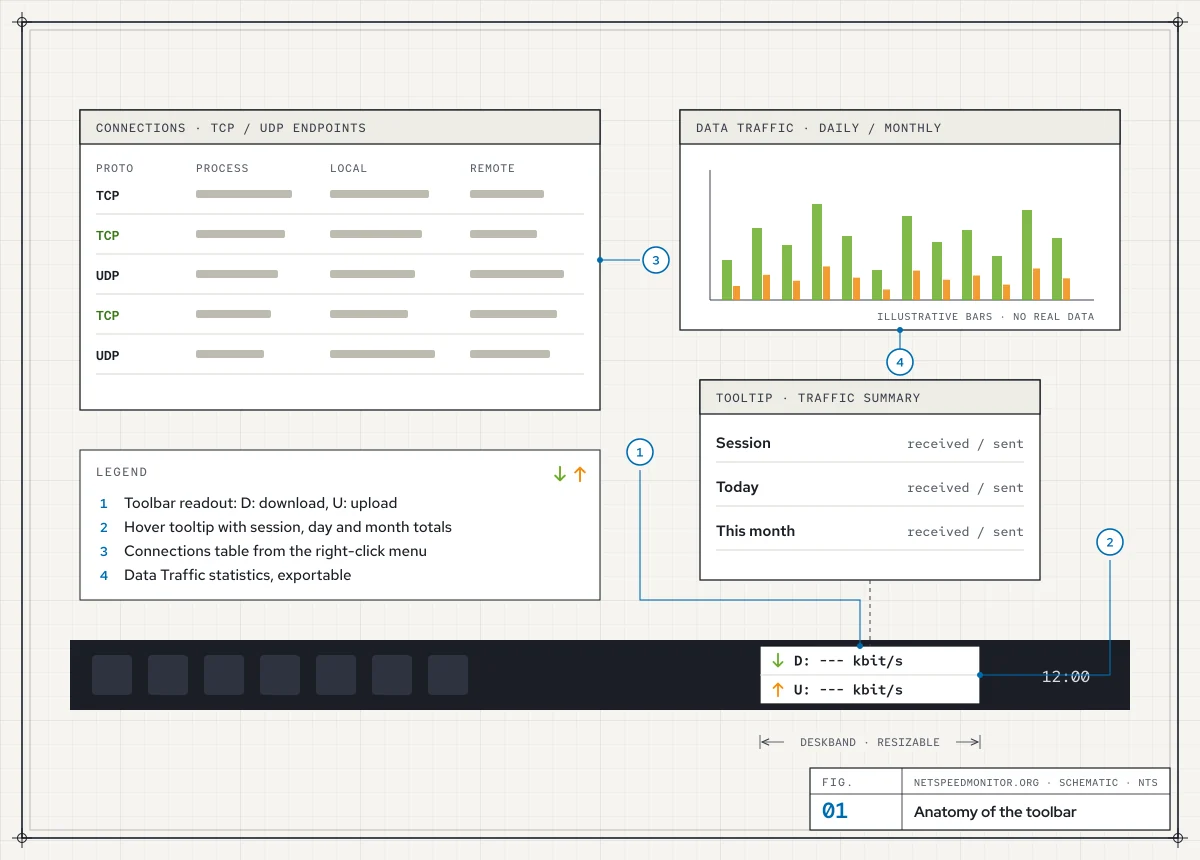
Florian Gilles wrote it for Windows XP, Server 2003, Vista and Windows 7, in 32-bit and 64-bit builds. It reads the traffic counters Windows already keeps for the adapter, so it needs no extra drivers and sends no test traffic of its own. Behind the two-line readout there is more: a hover tooltip with session, daily and monthly totals, a Connections table listing TCP and UDP endpoints, and a Data Traffic window with daily and monthly statistics you can export.

Version 2.5.4.0 from April 2010 is the last release. The developer's own site no longer offers it, and the program has not been updated for newer Windows. It still installs on Windows 8 and 10 with compatibility mode, and the toolbar works there because those versions keep taskbar toolbars. Windows 11 removed that toolbar slot, which is the single most important thing to know before you download it.

Blueprint-style drawing of NetSpeedMonitor's parts: the two-row toolbar on the taskbar, the hover tooltip with session, today and month totals, the Connections table of TCP and UDP endpoints, and the Data Traffic statistics window.

Sheet 03 · Features

Seven plates: what NetSpeedMonitor can do

The toolbar is the part everyone sees. The useful extras live one click away in its right-click menu. Each plate below describes one part, with a note on where to find it.

PL-01 · ToolbarAlways visible

Live download and upload rate on the taskbar

Two rows, D: and U:, refresh continuously beside the clock. The rate is measured on the adapter you pick, so it covers everything on the PC: browsers, updates, game launchers and cloud sync.

Right-click the readout → Configuration → Layout to change font and size, which helps on vertical taskbars.
PL-02 · TooltipHover

Traffic totals at a glance

Hovering over the toolbar opens a short summary: data received and sent in the current session, today and this month. That is the quickest way to keep an eye on a capped or metered plan.

Totals belong to the selected adapter only. Switch adapters and you start a different count.

PL-03 · ConnectionsRight-click

See which program is talking

The Connections table lists TCP and UDP endpoints with the process that owns them. Download-site changelogs for 2.5.4.0 mention copying a process name or path and ending a running process from here.

PL-04 · Data TrafficRight-click

Daily and monthly statistics you can export

Illustrative bars · received (green) and sent (orange)

The Data Traffic window keeps per-day and per-month totals for the monitored adapter, and its reports can be exported and imported again, which is handy before you reinstall Windows.

PL-05 · ConfigurationRight-click

Units, adapter and layout

Choose the network interface, switch the bitrate from the default kbit/s to kB/s or larger units, and adjust labels and font so the readout fits your taskbar.

kbit/skB/sMbit/sMB/s
PL-06Shortcut

Quick Links

Jumps straight to Windows' Network and Network Connections folders from the toolbar menu.

PL-07 · FootprintDesign

No extra drivers

Unlike packet-capture tools, it reads the counters Windows already keeps, so there is no network driver or filter to install. The trade-off: it reports totals per adapter, not per application.

Sheet 04 · How it works

From installer to readout: the route in four stations

The whole job takes a few minutes. Station 02 is the one people miss, and station 03 is the one that makes the numbers meaningful.

  1. 01
    Station 01 · Install

    Run the MSI for your edition

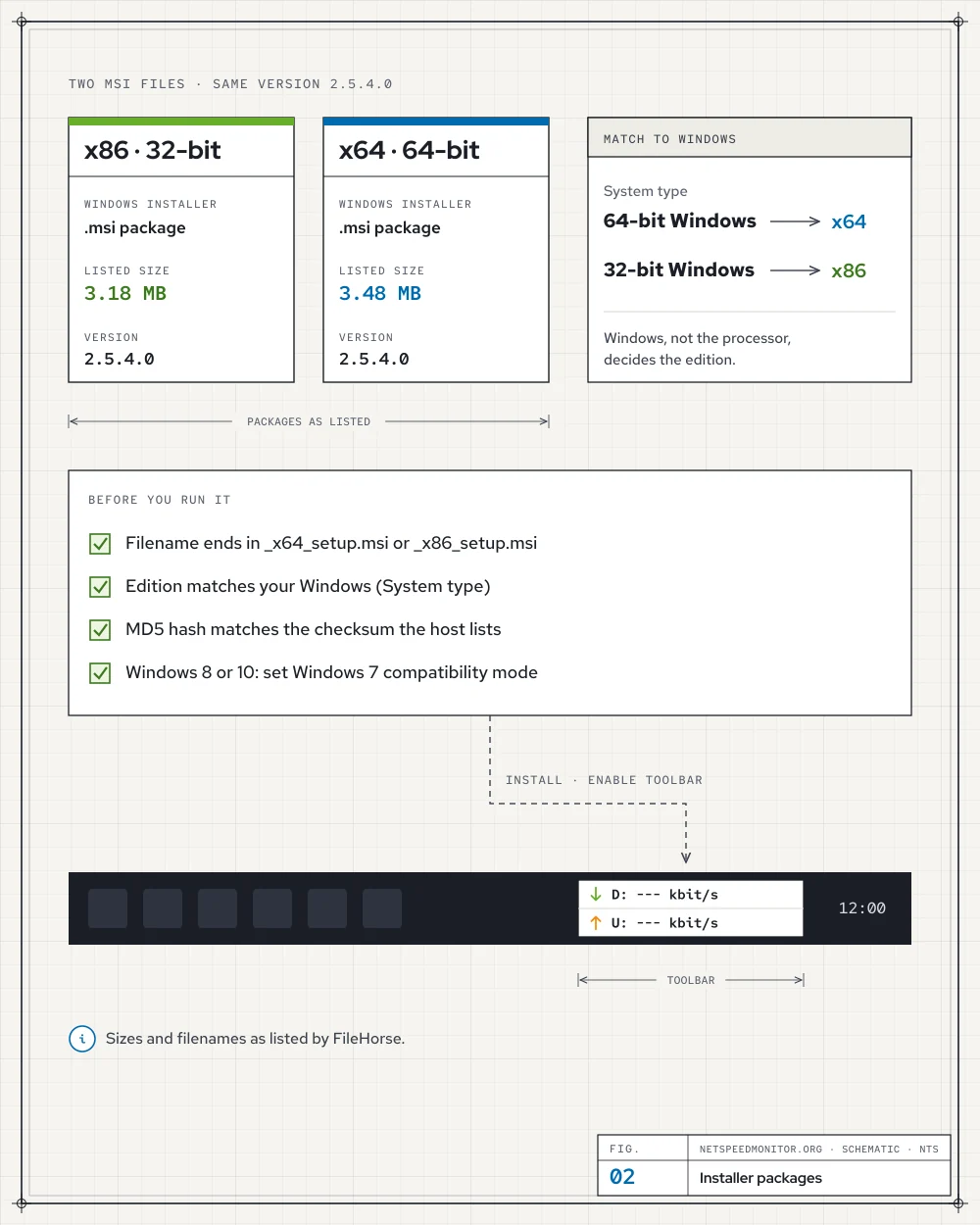
    Use the x64 package on 64-bit Windows and the x86 package on 32-bit Windows, then accept the administrator prompt.

    Windows 8 or 10 refusing it? Set the MSI to Windows 7 compatibility first.

  2. 02
    Station 02 · Attach

    Turn on the toolbar

    Answer Yes when Windows asks to add the NetSpeedMonitor toolbar, or tick it later under taskbar right-click → Toolbars.

    No Toolbars menu? You are on Windows 11's taskbar.

  3. 03
    Station 03 · Choose

    Pick the right network interface

    On first run, select the Ethernet or Wi-Fi adapter that actually carries your traffic, then save.

    A reading stuck at 0 nearly always means the wrong adapter.

  4. 04
    Station 04 · Read

    Watch, hover and right-click

    Read D: and U: at a glance, hover for totals, and right-click for Connections, Data Traffic and Configuration.

    Change kbit/s to kB/s if you think in file sizes.

Sheet 05 · Release information

Release information: one final build

There is no release schedule to follow. Everything below describes the build that download sites still list.

Latest version
2.5.4.0Final release
Release date
April 2010Reviews date it 5 April 2010
Developer
Florian GillesNo company behind it
Licence
FreewareClosed source
32-bit package
x86 · 3.18 MBnetspeedmonitor_2_5_4_0_x86_setup.msi
64-bit package
x64 · 3.48 MBnetspeedmonitor_2_5_4_0_x64_setup.msi
Languages
English, GermanPlus others, depending on the listing
Status
DiscontinuedNot offered by the original site
Revision block
Rev Date Changes as listed State
2.5.4.0 Apr 2010
  • Fixed version-check issues
  • Fixed installation with multiple users
  • Kill a running process; copy a process name or path
  • Minor bug fixes
Current
— Since 2010 No newer build. Releases labelled "Windows 11 edition" or "3.0" are not from the developer. None

What "discontinued" means in practice

The program will not receive fixes for newer Windows builds or security updates. That matters less for a passive meter than for a browser, but it is the reason compatibility mode is needed on Windows 8 and 10 and why Windows 11 is a poor fit.

The change list above is the summary printed on the FileHorse listing; we have not seen an original changelog from the developer.

Sheet 06 · Compatibility

Compatibility, version by version

"Supports Windows 10" on a download page usually means "installs with a workaround". This matrix separates what the program was built for from what people get working today.

  • Built for it, works as designed
  • Works with a workaround
  • No toolbar or no version
NetSpeedMonitor 2.5.4.0 compatibility by operating system
System Status Installer Notes
Target systems
Windows XP · Server 2003 Built for x86 / x64 MSI Original target. Both editions were released.
Windows Vista Built for x86 / x64 MSI Installs and adds the toolbar normally.
Windows 7 Built for x86 / x64 MSI The best fit. Note that Windows 7 itself no longer gets updates.
Later Windows
Windows 8 · 8.1 Workaround Compatibility mode The installer reports an unsupported OS unless it runs in Windows 7 compatibility mode.
Windows 10 Workaround Compatibility mode Toolbar works via taskbar → Toolbars. Expect occasional glitches after big Windows updates.
Windows 11 No toolbar May install The new taskbar has no toolbar (deskband) support, so the readout has nowhere to appear.
Other platforms
macOS No version — Windows only. Mac users need a different tool.
Linux No version — Windows only.

Some download pages list Windows 10 or 11 as supported. Those lists come from the hosts, not the developer, who stopped at Windows 7. Details per version: Windows 10 guide, Windows 11 guide.

Sheet 07 · Use cases

Where a taskbar meter earns its space

  1. U-01

    Catching a background upload

    A steady U: figure while you are doing nothing points to cloud sync, a backup or an update being shared. Open Connections to see which process it is.

  2. U-02

    Watching a capped plan

    The month total in the tooltip is a simple running count for mobile hotspots, satellite links and other metered connections.

  3. U-03

    Knowing whether a download has stalled

    A progress bar that has not moved could be a slow server or a dead transfer. A D: reading near zero settles it.

  4. U-04

    Comparing Wi-Fi and Ethernet

    Switch the monitored adapter and watch the same large download on each. It is a rough but honest comparison of real throughput.

  5. U-05

    Keeping older PCs useful

    On a Windows 7 workshop or media PC, it is a native, light way to see that the machine is online and moving data.

  6. U-06

    Sanity-checking a speed test

    Run a speed test and watch the toolbar at the same time. If D: stays far below the test result during normal use, the bottleneck is the server, not your line.

Drawing of the two NetSpeedMonitor 2.5.4.0 installer packages, x86 at 3.18 MB and x64 at 3.48 MB, with a pre-install checklist and the toolbar on a taskbar.

Sheet 09 · Download

Download NetSpeedMonitor 2.5.4.0

The final version of the taskbar network meter, as a Windows Installer (MSI) package. Free to use, no account needed.

Version
2.5.4.0 (final)
Licence
Freeware
Built for
Windows XP, Vista, 7
Windows 8 / 10
With compatibility mode
Windows 11
No toolbar on the new taskbar
Editions
x86 and x64 MSI files
Download NetSpeedMonitor

Sheet 10 · Installation / setup

Installation procedure

Written for Windows 10, with the steps that differ on Windows 7 and 8 marked. On Windows 11, read step 5 before you start.

  1. Check whether Windows is 32-bit or 64-bit

    Settings → System → About → System type. A "64-bit operating system" needs the x64 package; only a 32-bit Windows needs x86.

  2. Download the matching MSI

    Use the download section. The file should be named netspeedmonitor_2_5_4_0_x64_setup.msi or …_x86_setup.msi.

  3. Set compatibility mode Win 8 / 10

    Right-click the MSI → Properties → Compatibility → tick Run this program in compatibility mode for → choose Windows 7 → Apply. On Windows 7 and earlier, skip this step. See detail B.

  4. Run the installer

    Double-click the MSI, accept the User Account Control prompt and finish the short wizard.

  5. Add the toolbar Key step

    When Windows asks whether to add the NetSpeedMonitor toolbar, choose Yes. If you missed it, right-click an empty part of the taskbar → Toolbars → NetSpeedMonitor (detail A). On Windows 11 this menu does not exist; see the Windows 11 guide.

  6. Select the network interface

    Pick the adapter that carries your internet traffic (usually the Ethernet controller or the Wi-Fi adapter, not a VPN or virtual switch) and save.

  7. Fit it to your taskbar

    Unlock the taskbar to resize the toolbar, then lock it again. Right-click the readout → Configuration to change units, labels or font.

Detail ATaskbar → Toolbars

Windows 7, 8 and 10 keep this submenu. Ticking NetSpeedMonitor docks the readout beside the notification area.

Detail BMSI → Properties

Without this, newer Windows reports that the operating system is not supported and stops the install.

Sheet 11 · Troubleshooting

Troubleshooting: symptom → fix

Seven problems cover almost every report about NetSpeedMonitor on modern Windows. Work down the list; the first three solve most cases.

  • T-01

    Installer says the operating system is not supported

    Likely cause: Windows 8, 8.1 or 10 without compatibility mode.

    Set the MSI to Windows 7 compatibility (Properties → Compatibility), then run it again.

    If the Compatibility tab is missing, right-click the MSI → Troubleshoot compatibility and tell the troubleshooter the program worked on Windows 7.

  • T-02

    The toolbar does not appear after installing

    Likely cause: toolbar not switched on, or Explorer has not reloaded it.

    Right-click the taskbar → Toolbars → tick NetSpeedMonitor.

    If it is ticked but invisible, untick and tick it again, or restart Windows Explorer from Task Manager.

  • T-03

    The readout stays at 0 kbit/s

    Likely cause: the wrong network interface is selected.

    Right-click the readout → Configuration and choose the adapter that is connected. VPN, Hyper-V and other virtual adapters often show nothing.

    Full walkthrough: fixing a 0 kbit/s readout.

  • T-04

    The numbers look eight times too high or too low

    Likely cause: bits versus bytes.

    The default unit is kilobits per second. Browsers show megabytes per second. Switch the bitrate unit to kB/s or MB/s in Configuration, or divide by eight.

  • T-05

    There is no Toolbars menu on the taskbar

    Likely cause: you are using the Windows 11 taskbar.

    Windows 11 dropped taskbar toolbars. Use Task Manager → Performance, or a meter built for Windows 11. See the Windows 11 options.

  • T-06

    The readout vanished after a Windows update

    Likely cause: a feature update reset taskbar toolbars.

    Re-enable it under Toolbars. If that fails, uninstall, set compatibility mode on the MSI again and reinstall; your adapter choice may need to be set again.

  • T-07

    Text is cut off or overlaps on a small or vertical taskbar

    Likely cause: default layout is wide.

    Configuration → Layout: shorten the labels, use a smaller font, or drag the toolbar wider while the taskbar is unlocked.

Sheet 13 · Pros and cons

Pros and cons, measured against the same datum

Pros

  • Always in viewThe readout lives on the taskbar, so you never open a window to check traffic.
  • Light and driver-freeIt reads counters Windows already keeps instead of capturing packets.
  • More than a speedometerSession, daily and monthly totals, plus a Connections table.
  • FreeNo adverts, account or trial period.
  • Native on Windows 7Installs and runs without workarounds on the systems it was built for.

Cons

  • Abandoned since 2010No fixes, no security updates, no support channel.
  • Workarounds on Windows 8 and 10The installer needs compatibility mode and updates can knock the toolbar off.
  • No toolbar on Windows 11The standard taskbar has nowhere to show it.
  • One adapter at a timeTotals and rates follow the selected interface only.
  • Windows onlyNo macOS or Linux version exists.

Sheet 14 · FAQ

Frequently asked questions

Twenty answers in two chapters. Use the arrow keys to move between questions.

CH. A

Using NetSpeedMonitor

A.01–A.10

Two continuously updated rates on the taskbar: how fast data is being received (D:) and sent (U:) through one network adapter. Hovering adds session, daily and monthly totals; right-clicking opens the Connections table, Data Traffic statistics and Configuration.

D: is the download rate, data arriving at your PC. U: is the upload rate, data leaving it. Both are measured on the adapter selected in Configuration, so they include every program on the machine, not just your browser.

Kilobits per second is the default. Open Configuration from the right-click menu and change the bitrate unit to kB/s, MB/s or Mbit/s. If you compare with download dialogs that show megabytes, remember that one byte is eight bits.

The one that carries your internet traffic: usually the Ethernet controller on a wired PC or the Wi-Fi adapter on a laptop. VPN, Hyper-V, VirtualBox and loopback adapters tend to show little or nothing. If a reading stays at zero, change the adapter first.

Hover over the toolbar for a quick summary of the session, today and this month. For the full history, right-click the readout and open Data Traffic, which lists totals per day and per month.

It lists open TCP and UDP endpoints together with the program that owns each one, which helps when you want to know what is using the connection. Download-site notes for 2.5.4.0 also mention copying a process name or path and ending a process from that table.

Yes. The Data Traffic window can export its report and import it again later, which is useful before you reinstall Windows or move to another PC. Keep in mind that the statistics only cover the adapter that was being monitored.

It reads the byte counters Windows keeps for each network interface and turns the change over time into a rate. Because it does not capture packets, it needs no extra driver, sends no traffic of its own and cannot show per-application speeds on the toolbar itself.

No. A speed test sends a short burst of traffic to a test server to estimate the maximum your connection can do. NetSpeedMonitor shows what your PC is actually transferring right now. The two answer different questions and are not related products. Read the comparison.

Untick it under taskbar right-click → Toolbars first, then remove NetSpeedMonitor from Settings → Apps or from Programs and Features. If Windows reports a file in use, sign out or restart Windows Explorer and try again.

CH. B

Download, Windows versions & alternatives

B.01–B.10

No. netspeedmonitor.org is an independent guide. NetSpeedMonitor was written by Florian Gilles, and his own site no longer offers the program. The download button on this page leads to FileHorse, a third-party host.

Yes. It was released as freeware, with donations welcome, and it has no adverts, trial period or paid edition. It is not open source; the source code was never published.

Version 2.5.4.0, released in April 2010, is the final build. Anything presented as a newer official release, such as a "3.0" or a "Windows 11 edition", did not come from the developer.

Usually, with one workaround: set the MSI installer to Windows 7 compatibility mode before running it, then enable the toolbar under taskbar → Toolbars. Large Windows updates can occasionally turn the toolbar off again. Windows 10 guide.

Not on the standard Windows 11 taskbar. Windows 11 removed taskbar toolbars, which is exactly where NetSpeedMonitor draws its readout. Task Manager and newer taskbar meters are the practical options. Windows 11 guide.

Match your Windows, not your processor. On a 64-bit Windows install the x64 MSI; use x86 only on a 32-bit Windows. Check under Settings → System → About → System type. More on choosing the installer.

Yes. Windows 7 is one of the systems it was built for, so it installs and adds its toolbar without compatibility tricks. Windows 7 itself no longer receives security updates, which is worth weighing separately.

No. NetSpeedMonitor is Windows-only and there has never been a macOS version. On a Mac, Activity Monitor's Network tab shows live traffic, and third-party menu bar apps can put a speed readout at the top of the screen. Mac options.

No. It is closed-source freeware with no public repository. Projects on GitHub with similar names are unrelated or are separate open-source alternatives. What you will find on GitHub.

The original MSI is a small, passive tool, but it is unmaintained and runs inside Explorer. Download it from a reputable host, confirm the filename and checksum, scan it, and avoid repackaged "new versions". The safety notice lists the checks.